
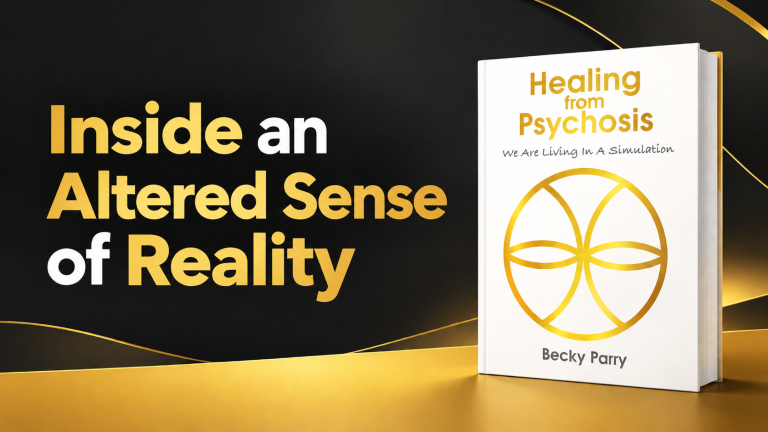
One reason psychosis is difficult to explain is that it changes the very thing people normally use to judge an experience: their sense of reality. When someone asks what does psychosis feel like, a list of symptoms only answers part of the question. Hallucinations, delusions, and disorganized thinking are clinical terms. The person experiencing them may instead describe fear, certainty, confusion, significance, sensory intensity, spiritual meaning, or a feeling that the ordinary world has somehow changed.
There is no universal internal experience of psychosis. Two people can receive similar clinical descriptions while experiencing the episode in completely different ways.
The World May Look the Same but Feel Completely Different
Psychosis does not always mean seeing a dramatically different physical world.
Sometimes the room still looks like the room.
The television is still in the corner. Cars still pass outside. Family members look familiar.
What changes can be the meaning attached to these ordinary things?
A television program may suddenly feel personally directed. A coincidence may seem impossibly significant. A stranger’s glance might feel threatening. A sound other people barely notice may seem loaded with meaning.
This change in significance can make the environment feel unfamiliar even when nothing visible has changed.
Clinically, psychosis involves some loss of contact with shared reality and may involve hallucinations, delusions, or disordered thinking. Importantly, these experiences may feel extremely real to the person. The related article on psychosis vs. schizophrenia explains how an episode differs from a diagnosis.
That helps answer the more personal question: what does a psychosis feel like?
It may feel less like “believing something strange” and more like suddenly becoming certain that you have discovered an important truth.
Hearing a Voice Is Not the Same as Imagining a Voice
People sometimes assume a hallucination is comparable to imagining somebody’s voice in their head.
That comparison can be misleading.
An auditory hallucination can have the quality of something heard rather than voluntarily imagined. Voices may seem to come from inside or outside the head. They may speak directly to the person, comment on their behavior, argue with one another, comfort them, frighten them, or give instructions.
The emotional response depends heavily on what is being heard.
A reassuring voice and a threatening voice are very different experiences.
NIMH notes that hearing voices is common among people with schizophrenia and that some people may hear them for a considerable period before others realize something has changed.
Becky Parry writes openly about hearing many different voices during her own episodes. She describes some experiences as supportive and others as deeply frightening. She does not interpret those experiences in the same way as her doctors, which becomes one of the central tensions in Healing from Psychosis: We Are Living in a Simulation.
Her account gives readers something a diagnostic checklist cannot: a sense of how emotionally complicated the experience can become.
Certainty Can Be More Powerful Than Doubt
People outside an episode often ask, “Didn’t you know it wasn’t real?”
That question assumes the person had access to the same doubt that an outside observer has.
Sometimes they do.
Sometimes they do not.
Sometimes doubt appears for a few moments and disappears again.
This is one of the most difficult parts of the psychosis experience to understand from the outside.
Imagine having a memory that you know happened yesterday. You do not wake up each morning and investigate whether it was real. You simply know.
A strongly held psychotic belief may carry that same emotional certainty.
That is one reason blunt confrontation does not necessarily help. Telling someone, “That’s ridiculous,” may feel to them like being told that an event they plainly remember never happened.
The emotional effect may be anger, fear, withdrawal, or increased distrust.
Thoughts Can Become Fast, Crowded, or Hard to Organize
Psychosis is not only about what somebody sees or hears.
Thinking itself can change.
Ideas may arrive rapidly. One thought may connect to another with unusual speed. A person may notice patterns everywhere or feel overwhelmed by connections that seem obvious to them but difficult to explain to anyone else.
Speech can become difficult to follow when the internal stream of thought is moving faster than conversation can contain.
For some people, this is energizing at first.
For others, it is immediately frightening.
Eventually, constant mental activity can become exhausting.
The NHS includes confused or disordered thinking and speaking among the main features of psychosis.
Ordinary Coincidences May Stop Feeling Ordinary
Most people notice coincidences occasionally and then continue with their day.
During psychosis, coincidence can carry enormous weight.
A song might play at exactly the “right” moment. A number may appear repeatedly. Somebody might say a sentence that seems to answer a private thought. Several unrelated events may begin to feel connected by an unseen pattern.
This kind of altered perception is not always about the eyes or ears. It can involve altered meaning.
That difference is important.
A person’s senses may be working normally while their interpretation of events has changed dramatically.
Psychosis Can Feel Spiritual to the Person Experiencing It
Some psychotic experiences contain religious, mystical, supernatural, or spiritual themes.
This creates a sensitive boundary.
Spiritual belief by itself is not mental illness. Religious practices and unusual beliefs exist across cultures and communities. Clinicians have to consider cultural context, distress, functioning, risk, and the wider symptom picture rather than assuming that an unconventional belief is automatically pathological.
At the same time, psychosis can take on religious or spiritual content.
Becky Parry‘s memoir sits directly inside this complicated territory. She describes her experiences through ideas involving spirituality, parallel realities, supernatural forces, frequencies, clairvoyance, and simulation theory. In the introduction, she openly states that she interprets reality differently from the conventional medical account.
For a responsible reader, two things can be held at once.
Her interpretation is genuinely hers.
It does not automatically establish that the interpretation is an objective explanation of psychosis for everyone else.
That distinction allows lived experience to be respected without turning one person’s explanation into a universal clinical conclusion.
Fear Can Become Physical
Psychosis can be intensely emotional.
If someone believes they are being watched, followed, controlled, punished, or threatened, their body can respond as if that danger is physically present.
Their heart may race.
Sleep can become difficult.
They may repeatedly check windows or doors.
They might avoid people they once trusted.
They may leave home suddenly or seek somewhere they believe is safer.
To an observer, the behavior may seem irrational. From inside the experience, it may feel like a logical response to danger.
This is why simply removing the “belief” from a description of psychosis leaves out so much.
The fear attached to it can be overwhelming.
Psychosis Does Not Always Feel Frightening
This part is often overlooked.
Some experiences can initially feel meaningful, beautiful, energizing, comforting, or spiritually significant.
A person may feel unusually connected to other people or to the universe. They may believe they have discovered a purpose. Colors, music, nature, or coincidences may feel more intense.
This matters because a person may not immediately want those experiences to stop.
Treatment conversations can become difficult when clinicians see risk while the individual sees meaning.
The most useful care, therefore, has to consider more than symptom reduction. It should also involve the person’s goals, concerns, values, relationships, and understanding of what happened.
NIMH’s approach to coordinated specialty care specifically emphasizes shared decision-making and recovery goals rather than treating the person as a passive recipient of treatment.
Isolation Can Hurt as Much as the Episode
Another overlooked part of living with psychosis is what happens socially.
People may become frightened of telling anyone what they are experiencing.
They worry they will be mocked.
They worry somebody will call them “crazy.”
They worry friends will disappear.
They worry their diagnosis will become the first thing everyone sees.
Becky’s earliest diary entries contain this sense of isolation repeatedly. She describes feeling that nobody could understand what she had experienced and that the loss of connection was one of the most painful parts of the aftermath.
This is where stigma creates a second problem on top of the first.
Someone may already be trying to recover from an overwhelming episode while also deciding who can safely be told about it.
What Happens After the Acute Episode?
When obvious psychotic symptoms improve, people around the person may assume the crisis is over.
For the individual, that may be only the beginning.
They may be exhausted.
They may feel embarrassed by things they said or did.
Friendships may have changed.
Work or education may have been interrupted.
Hospitalization itself may have been frightening.
They may be trying to understand which memories belong to the episode and how to make sense of them now.
They may also be adjusting to medication or dealing with side effects.
Recovery can therefore involve much more than the disappearance of hallucinations or delusions.
In Becky’s case, writing becomes part of that meaning-making process. She says the manuscript began as a diary intended to help her work through pain, trauma, and suffering.
That is one of the strongest qualities of the memoir. Readers see the aftermath rather than only the crisis.
Is It Like Being in a False Reality?
The phrase “false reality” can be useful from the outside but uncomfortable from the inside.
Clinically, psychosis may involve difficulty distinguishing between experiences that are externally verifiable and those generated or interpreted differently by the mind.
But telling someone, “You are living in a false world,” may not help them.
A better starting point is curiosity about what they are experiencing.
You might ask:
- What are you noticing right now?
- Is it frightening or comforting?
- Have you been sleeping?
- Do you feel safe?
- Are the voices telling you to do anything?
- Is there somebody you trust who can stay with you?
- Would you be willing to speak with a mental health professional?
Those questions focus on safety and experience rather than winning an argument.
What Support Can Feel Helpful?
People are different, but several principles can make communication easier.
Stay calm.
Listen.
Do not mock the person’s account.
Avoid enthusiastically confirming claims you cannot verify.
Acknowledge emotion.
Reduce unnecessary stimulation if the person is overwhelmed.
Encourage professional support.
If there is immediate danger, urgent help may be required.
Psychosis should be assessed promptly because earlier treatment is associated with better outcomes. NHS guidance advises seeking medical help when symptoms of psychosis appear, while NIMH emphasizes early access to treatment and coordinated care.
The Experience Is Bigger Than a Symptom List
Clinical terminology matters because it helps professionals communicate and plan treatment.
Lived experience matters because it tells us what those words feel like from inside a person’s life.
Both are needed.
Psychosis may involve hearing voices, developing fixed beliefs, feeling surrounded by unusual meanings, struggling to organize thoughts, or finding ordinary reality suddenly unfamiliar.
It can also involve shame, loneliness, wonder, certainty, terror, grief, exhaustion, and confusion.
There is no single sentence that describes everybody’s experience.
That may be the most important answer of all.
FAQs
Does a person know they are experiencing psychosis?
Sometimes. Awareness varies greatly. A person may recognize that something is unusual while still believing a particular experience is real. Insight can also change during and after an episode.
Can psychosis feel completely real?
Yes. Hallucinations and delusions can feel highly convincing to the person experiencing them. That is one reason calm, respectful communication is important.
Does everyone with psychosis hear voices?
No. Hearing voices is one possible symptom, but psychosis can involve different combinations of hallucinations, delusions, and disorganized thinking.
Can someone remember what happened during psychosis?
Many people remember at least parts of an episode, although memories can vary. Some experiences may later be difficult to organize or interpret because the episode itself was confusing or overwhelming.
Can someone recover after experiencing psychosis?
Yes. Outcomes vary, but recovery is possible. Some people never experience another episode after treatment, while others learn to manage recurring symptoms and still lead meaningful, productive lives.